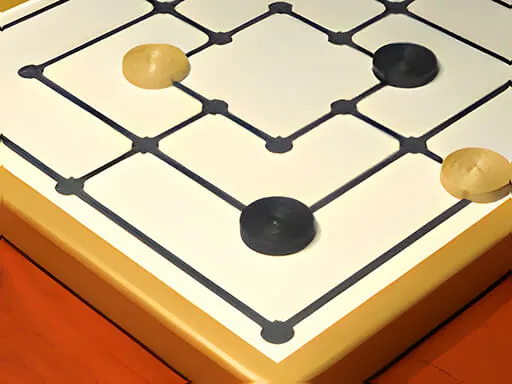
Gomoku Mini Pizza Edition
Five stones. That is the entire game. Gomoku Mini Pizza Edition hands you a grid, a pile of black and white stones, and one job: line up five in a row before your opponent does. It sounds like a one-minute distraction — until the computer blocks your fourth stone, sets a trap of its own, and beats you on move fourteen.
The “mini” in the name is a promise, and the game keeps it. No accounts, no downloads, no thirty-minute commitment. You open the page, place stones, and within minutes you are either celebrating a clean five-in-a-row or staring at the board wondering where it went wrong. Gomoku Mini Pizza Edition is real strategy without the homework — a board-game brain workout that respects your time.
Gomoku Mini Pizza Edition: The Five-Minute Mind Duel
At its core, this is two minds, one board, zero luck. Every stone you place in Gomoku Mini Pizza Edition stays where you put it. Nothing gets captured, nothing moves, no dice roll bails you out. When you win, it is because you out-thought someone. When you lose, you know exactly which move did it — and that sting pulls you back for one more round.
Most matches last five to ten minutes, and that short loop changes everything. You can experiment, try a wild opening, lose fast, and learn something before your tea cools. Play the computer on climbing difficulty levels, or face a friend on the same screen — every match becomes a grudge match with bragging rights on the line.
The Entire Game in 60 Seconds
If you can count to five, you can play gomoku — the rules fit in a single breath, which is why the game has survived thousands of years.
The board
The classic board is a 15×15 grid, and you play on the intersections where lines cross. Gomoku Mini Pizza Edition follows this tradition: each crossing holds one stone, placed with a click or tap, and stones never leave.
The turns
Black always moves first, then players alternate one stone per turn. Against the computer you are usually black; in two-player mode, agree fairly on who gets it — it matters more than beginners expect.
How you win (and draw)
The first player to form an unbroken line of five stones wins instantly — horizontally, vertically, or diagonally, all three count equally. If the board fills with no winner, it is a draw, though most matches end long before that.
Your First Three Games: A Starter Plan
Knowing the rules and knowing what to do are different skills. Most beginners lose the same way: they build pretty lines while the opponent quietly builds five somewhere else. This three-game plan skips the most painful part of the learning curve.
Game 1 — take the center
Put your first stone near the middle. A central stone can grow in all four directions; an edge stone only in two or three — like fighting with one hand tied. In Gomoku Mini Pizza Edition the opening stone shapes everything after it — start strong, start central.
Game 2 — block everything
Make defense your only job for one whole game. Every turn, check your opponent’s stones first and block anything nearing three in a row. It feels passive, but beginners lose because they never block, not because they never attack — you will be surprised how many games pure blocking wins.
Game 3 — build your own line
Now split your attention: each turn, ask what your opponent threatens and what you are building. The best moves do both — a stone that extends your line while blocking theirs.
Four Patterns That Decide Every Match
Gomoku has a vocabulary, and learning it is like getting glasses — the board snaps into focus. Every match you will ever play is decided by these four patterns.
The open three
Three stones in a row with both ends empty. This is the pattern that matters most for beginners: it becomes an unstoppable open four in one move. When your opponent builds one, answer it immediately. When you build one, your opponent must answer it — which hands you the initiative.
The open four
Four in a row with both ends open. This wins on your next move no matter what — blocking one end still leaves the other. Aim your whole midgame at building one while stopping your opponent from doing the same.
The fork
One stone creating two winning threats at once — the crown jewel of gomoku strategy. Your opponent can only block one threat per turn, so two simultaneous threats means one always gets through. If you ever land a fork in Gomoku Mini Pizza Edition, savor it — strong players spend entire matches maneuvering toward exactly that moment.
The overline
Six or more in a row. Under the casual freestyle rules used here, an overline still wins. Strict tournament rules (called Renju) treat overlines differently — but here, five or more in a row takes the match.
Climbing the AI Difficulty Ladder
The computer opponent in Gomoku Mini Pizza Edition is really a training program. Start on easy and use it as a sandbox for center openings and basic blocking — easy forgives mistakes, which is what you want while the patterns sink in. Move up after three or four comfortable wins.
Medium is where the game gets honest: the AI punishes open threes and sets traps. Replay the games you lose and find the move where the missed fork appeared — reviewing losses improves players faster than anything else.
Hard mode thinks several moves ahead and exploits every lazy move. Don’t be discouraged if it beats you ten times in a row; it beats almost everyone at first. Play in short sessions, focus on surviving longer each game, and celebrate small victories: the blocked fork, the ten extra moves you lasted. The difficulty ladder in Gomoku Mini Pizza Edition is one of the best ways to learn the game, because the feedback is instant and the lessons are free.
Two Players, One Screen: Beating Your Friend
Everything changes when the opponent sits next to you. Two-player mode turns quiet strategy into psychological warfare. You see your friend’s face when they spot your trap. You feel the tension when both of you notice the same fork forming.
Keep a straight face and count threats silently. Over-aggression loses more friendly games than anything else, and alternating who plays black each game keeps things honest — black moves first and holds a proven mathematical edge.
Two Thousand Years of Five in a Row
People were playing this game before most modern nations existed. Gomoku was invented in China over two thousand years ago — “go” means five, “moku” means points in Japanese. It traveled the world as Wuziqi in China, Omok in Korea (still a cultural staple every child learns), and Caro in Vietnam.
As early as 1899, the first player’s advantage was proven mathematically. Instead of killing the game, that discovery deepened it: competitive players invented balancing systems like Renju’s forbidden moves and the Swap opening, where one player places the opening stones and the other chooses a color. When you play Gomoku Mini Pizza Edition, you are joining the longest-running strategy tradition in gaming — now with an undo button.
5 Mistakes Every Beginner Makes
- Playing on the edge. Edge stones grow in fewer directions. Stay central until the midgame fills the board naturally.
- Chasing your own five while ignoring their four. Opponent has four in a row? Nothing else matters — block it now or lose.
- Building single threats instead of forks. One threat gets blocked every time. Set up double threats and wins follow.
- Panicking when behind. A losing position isn’t a lost game until someone completes five. Calm blocking steals comebacks.
- Never reviewing losses. Every defeat contains the exact move where it went wrong. Find it once, never fall for it again.
Gomoku Mini Pizza Edition FAQ
How do you play gomoku?
Take turns placing black and white stones on a 15×15 grid’s intersections. The first player to form an unbroken line of five — horizontally, vertically, or diagonally — wins. Stones never move and are never captured.
What is the fastest way to win at gomoku?
Build open threes and grow them into open fours, then combine attacks into a fork: one move creating two unstoppable threats at once. A single threat gets blocked; two cannot.
What is an open three in gomoku?
Three stones in a row with both ends empty — one move away from an unstoppable open four. Never ignore your opponent’s open three; answer it immediately.
Does six in a row count as a win?
In casual freestyle rules, yes — six or more still wins. In strict tournament Renju rules, an overline doesn’t count and can even be a forbidden losing move for black.
Can I play gomoku unblocked at school?
Yes. Free browser versions like Gomoku Mini Pizza Edition need no downloads, accounts, or powerful hardware, making them easy to access on school and work networks.
That’s the full tour: the rules, the patterns, the AI ladder, and two thousand years of history behind five little stones. The best way to lock it in is to play a match of Gomoku Mini Pizza Edition right now — try the center opening, hunt for your first fork, and watch how the computer answers. Then come back and tell us in the comments: what was the cleverest trap you ever set, and did your opponent see it coming?